Generative AI is here to stay, and they're altering how users behave online, though probably not in the way you think.
ChatGPT isn't killing Google. Perplexity isn't making research obsolete. But these tools are fundamentally changing how your potential customers discover and evaluate solutions.
When someone asks a search engine or an AI chatbot a question about your segment, the underlying AI is pulling from its understanding of the web to shape its answer.
This creates a brand new opportunity for fast movers:
- If you're cited as a source, you're shaping how customers understand your entire category
- They form an opinion that coincides with your brand before they've even clicked through to anyone's site
This guide will show you exactly how to optimize for this new discovery layer: what Generative Engine Optimization actually means, why it matters for your startup, and how to balance it witheverything else on your marketing plate, including SEO.
What is GEO?
Generative Engine Optimization (GEO) is the practice of optimizing your content to be cited, linked, or summarized by generative AI and AI-powered search features. Much like SEO improving your ranking in traditional search, GEO improves the probability that your brand and content are featured across a broad range of AI-enabled tools:
- Standalone AI tools:
- ChatGPT
- Perplexity
- Claude
- Gemini
- AI-powered search summaries:
- AI Overviews
- Copilot
- Emerging AI features:
- Notion
- Slack
- Copilot
- Industry-specific AI assistants:
- Copilot
- Jasper
- Any platform where AI synthesizes information to answer questions
Instead of optimizing to rank higher in search results, like in SEO, you're optimizing to become a cited source of truth. Your content becomes part of AI's knowledge base, directly influencing how potential customers learn about the space you operate in.
Key technical terms
Large Language Model (LLM): AI system trained on vast amounts of text data to understand and generate human-like responses. They work by analyzing patterns in text to predict the most relevant information for any given query. Examples include ChatGPT, Claude, and Gemini. These models power both standalone AI chatbots and the AI summaries appearing in search engines.
Schema: Structured data markup that helps machines understand the context of your content. Similar to meta tags, this code gets added to your website's HTML (meaning that it’s not visible to users, but readable by machines). For a SaaS startup, you might add this to your homepage or product pages:
<script type="application/ld+json">

{

  "@type": "SoftwareApplication",

  "name": "Your Product",

  "applicationCategory": "BusinessApplication"

}

</script>
Semantic Structure: How your content is organized to convey meaning: clear headers, logical flow, and explicit relationships between concepts. This approach makes your content machine-readable without losing human appeal.
Why GEO matters
The relationship between AI-enabled tools and search engines reveals several important learnings about internet user behavior in 2025.
Chatbots vs Search Engines: Who’s Winning the Traffic War?
34x Gap AI chatbots drew 55.2B visits last year—just 2.96% of search engine traffic. Users still interact with search engines 34× more.
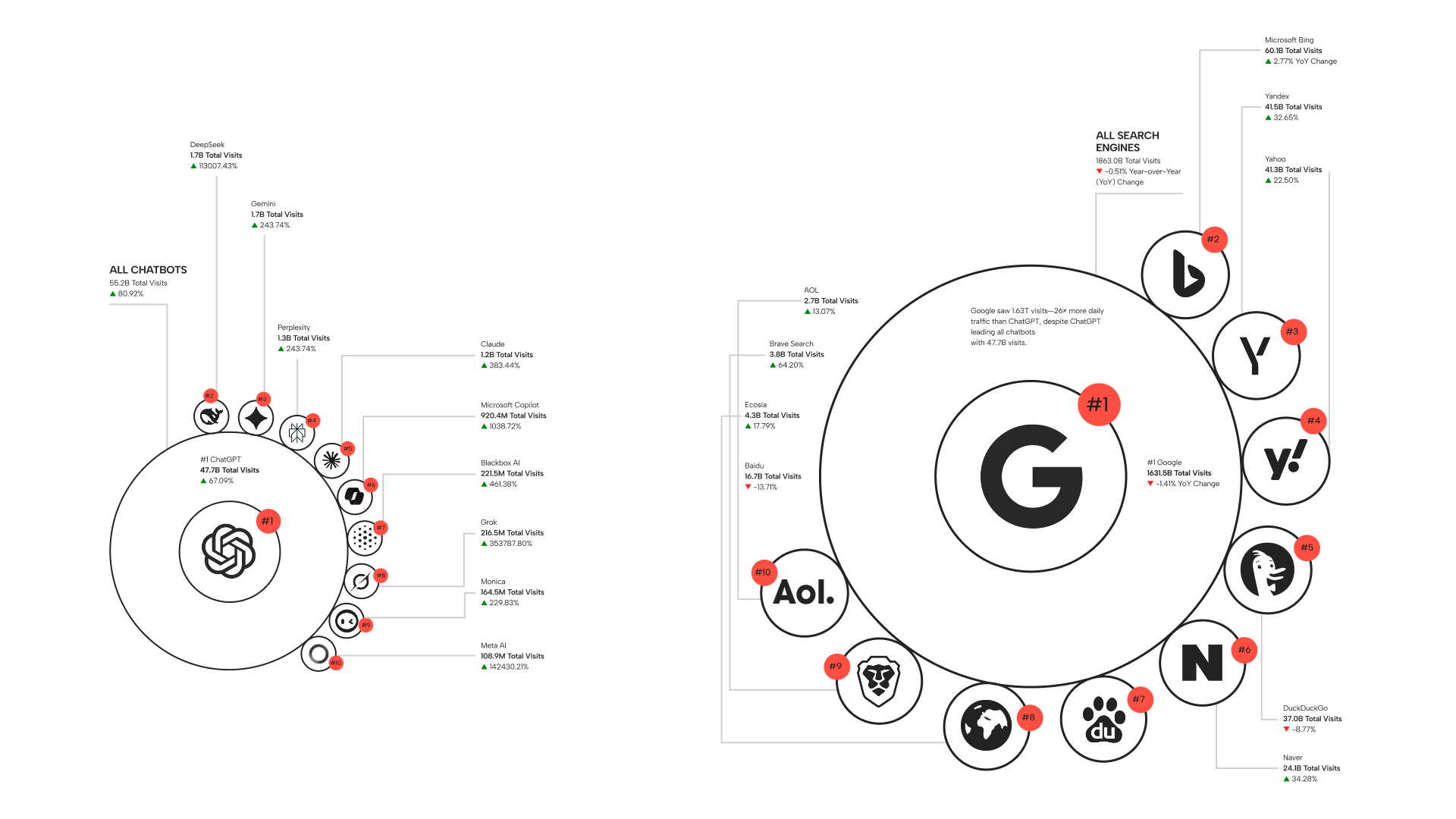
A data-backed comparison of the top 10 AI chatbots and search engines by total web traffic (Apr 2024 – Mar 2025). Despite explosive growth, chatbot traffic remains just 2.96% of search engine visits—pointing to a growing trend, not a takeover.
AI chatbots have seen remarkable growth: 80.92% year-over-year from April 2024 to March 2025, totaling 55.2 billion visits. Yet despite this surge, chatbot traffic accounts for only 2.96% of total search engine visits during the same period (source).
Key insight: AI isn't replacing search, it's creating a new layer for discovery.
When users do come from generative AI sources, their behavior is notably different:
- 8% higher engagement compared to traditional search visitors
- 12% more pages browsed per visit
- 23% lower bounce rate (source)
Key insight: Users from AI sources are more qualified and engaged.
Here's where it gets interesting:
- 3 in 5 people only sometimes trust AI Overviews
- 1 in 5 never trust them
- Yet across all age groups, more than 40% rarely or never check the underlying source
- Only 7.71% always follow the links provided (source)
Key insight: Users are forming opinions based on AI summaries without verifying sources. Being cited shapes perception even without the click.
Beyond traditional SEO
SEO remains crucial for discovery, but LLMs evaluate content through a completely different lens.
Traditional SEO is like optimizing your storefront for foot traffic on a busy street. GEO is like ensuring travel guides and local experts recommend your store when tourists ask for advice. Both matter, but they require different approaches.
What this means practically:
- Your homepage might already be perfectly optimized for best [your solution] software
- But if you lack clear, educational content explaining core concepts in your space, AI won’t cite you as an authority
- You need both the storefront (SEO) and the expertise (GEO)
Building Your GEO Strategy
The foundation of effective GEO is understanding that AI systems are looking for authoritative, educational content to cite as sources. This creates an opportunity to build content that establishes your expertise while serving real user needs.
Content that works for both humans and AI
Start by creating clear, educational content that answers the specific questions your customers ask. This means going beyond surface-level blog posts and developing comprehensive resources that demonstrate deep understanding of your space. When someone asks an AI about a problem you solve, you want your content to be the source that shapes that answer.
Essential content types for GEO:
- Educational foundations: Clear explainers for core concepts in your space
- Comparison resources: Structured, honest comparisons (including competitors)
- Expert glossaries: Definitions of industry terms and methodologies
The key is ensuring factual consistency across all your content. If your blog says one thing about a concept but your documentation says another, AI systems notice these inconsistencies. Every piece of content should reinforce your expertise and align with your broader knowledge base.
Beyond individual pieces, think about how you’re structuring this information. Add structured data (schema markup) and use semantic HTML to help AI systems understand not just what you’re saying, but how different concepts relate to each other. A well-structured glossary page with proper schema markup is far more likely to be cited than a blog post covering the same terms in paragraph form.
Finding your balance
There's no universal formula for balancing "source material" (educational content for AI) with thought leadership (perspective-driven content for humans). Your optimal mix depends entirely on your business model and marketing priorities.
Consider your context:
- Inbound-heavy SaaS targeting SMBs: 70% educational content, 30% thought leadership
- Technical developer tools: Deep technical content serves both audiences simultaneously
- Enterprise startup with founder-led sales: Flip the ratio since thought leadership opens doors
- Category creators: Heavy educational investment to define the space you're building
The key is thinking of your content as an ecosystem where everything works in synergy. Some pieces exist primarily for discovery. These are your encyclopedic, educational resources optimized for GEO. Others exist for engagement. These are your unique perspectives that resonate with your specific audience. The best content often serves both purposes.
Setting realistic expectations
GEO is becoming essential for organic discovery, much like SEO became essential in the 2000s. But not every company needs the same level of investment:
High GEO priority:
- Inbound-dependent businesses
- Category leaders or creators
- Technical products requiring education
- Competitive spaces where differentiation is crucial
Lower GEO priority:
- Pure outbound sales models
- Niche B2B with handful of customers
- Local services with geographic constraints
- Products sold through partnerships
Like early SEO, early movers in GEO have a temporary advantage. The space is still developing, AI systems are still learning, and most companies haven't started optimizing for it. This window won't last forever.
Technical implementation
Getting the technical foundation right doesn't require a complete overhaul of your existing content infrastructure. Most platforms now offer tools to help you optimize for both traditional search and AI discovery.
Platform-specific approaches:
- Webflow: Recently added AI optimization capabilities, so it is still emerging but functional for basic schema and semantic structure.
- WordPress: Established plugins now include schema markup generators. Start with your homepage and cornerstone content.
- Custom builds: Prioritize JSON-LD schema implementation and semantic HTML markup.
Regardless of your platform, focus on three technical elements: schema markup (particularly FAQ, How-to, and Article schemas), semantic HTML with clear heading structures, and consistent content organization across your site.
The challenge with measuring GEO
GEO is so new that the industry hasn't settled on standard metrics or attribution models. Unlike SEO, where you can track rankings, impressions, and clicks with precision, GEO operates in a black box. When ChatGPT cites your content, when Perplexity includes you in a summary, or when Google's AI Overview references your site, these events often happen without clear attribution. You might see the downstream effects but not the direct cause.
Current measurement limitations:
- No "AI rank tracking" equivalent exists yet
- AI platforms don't provide citation analytics
- Direct attribution from AI mentions to traffic is nearly impossible
- Results blend with overall organic performance
What you can track today
Despite these limitations, several proxy metrics can indicate whether your GEO efforts are working:
Trackable indicators:
- Branded search increases: People looking you up after seeing AI mentions
- “Direct" traffic spikes: Often mislabeled traffic from AI platforms
- New organic visitor behavior: Higher engagement rates from unfamiliar sources
- Content performance patterns: Which pages suddenly gain traction without ranking changes
- Manual mention monitoring: Periodic checks of how AI platforms discuss your space
Set up Google Analytics segments to track visitors with unusual behavior patterns, such as high engagement, multiple page views, but no clear referral source. These often indicate AI-driven discovery. Similarly, monitor which educational pages gain traffic without corresponding improvements in search rankings.
Conclusion
LLMs aren't replacing search engines, they're creating a new user behavior layer that sits between curiosity and decision. With AI chatbots driving significantly more engaged visitors despite capturing only 2.96% of search traffic, the opportunity is there to optimize ahead of the curve.
Generative AI is here to stay, and they're altering how users behave online, though probably not in the way you think.
ChatGPT isn't killing Google. Perplexity isn't making research obsolete. But these tools are fundamentally changing how your potential customers discover and evaluate solutions.
When someone asks a search engine or an AI chatbot a question about your segment, the underlying AI is pulling from its understanding of the web to shape its answer.
This creates a brand new opportunity for fast movers:
- If you're cited as a source, you're shaping how customers understand your entire category
- They form an opinion that coincides with your brand before they've even clicked through to anyone's site
This guide will show you exactly how to optimize for this new discovery layer: what Generative Engine Optimization actually means, why it matters for your startup, and how to balance it witheverything else on your marketing plate, including SEO.
What is GEO?
Generative Engine Optimization (GEO) is the practice of optimizing your content to be cited, linked, or summarized by generative AI and AI-powered search features. Much like SEO improving your ranking in traditional search, GEO improves the probability that your brand and content are featured across a broad range of AI-enabled tools:
- Standalone AI tools:
- ChatGPT
- Perplexity
- Claude
- Gemini
- AI-powered search summaries:
- AI Overviews
- Copilot
- Emerging AI features:
- Notion
- Slack
- Copilot
- Industry-specific AI assistants:
- Copilot
- Jasper
- Any platform where AI synthesizes information to answer questions
Instead of optimizing to rank higher in search results, like in SEO, you're optimizing to become a cited source of truth. Your content becomes part of AI's knowledge base, directly influencing how potential customers learn about the space you operate in.
Key technical terms
Large Language Model (LLM): AI system trained on vast amounts of text data to understand and generate human-like responses. They work by analyzing patterns in text to predict the most relevant information for any given query. Examples include ChatGPT, Claude, and Gemini. These models power both standalone AI chatbots and the AI summaries appearing in search engines.
Schema: Structured data markup that helps machines understand the context of your content. Similar to meta tags, this code gets added to your website's HTML (meaning that it’s not visible to users, but readable by machines). For a SaaS startup, you might add this to your homepage or product pages:
<script type="application/ld+json">

{

  "@type": "SoftwareApplication",

  "name": "Your Product",

  "applicationCategory": "BusinessApplication"

}

</script>
Semantic Structure: How your content is organized to convey meaning: clear headers, logical flow, and explicit relationships between concepts. This approach makes your content machine-readable without losing human appeal.
Why GEO matters
The relationship between AI-enabled tools and search engines reveals several important learnings about internet user behavior in 2025.
Chatbots vs Search Engines: Who’s Winning the Traffic War?
34x Gap AI chatbots drew 55.2B visits last year—just 2.96% of search engine traffic. Users still interact with search engines 34× more.
A data-backed comparison of the top 10 AI chatbots and search engines by total web traffic (Apr 2024 – Mar 2025). Despite explosive growth, chatbot traffic remains just 2.96% of search engine visits—pointing to a growing trend, not a takeover.
AI chatbots have seen remarkable growth: 80.92% year-over-year from April 2024 to March 2025, totaling 55.2 billion visits. Yet despite this surge, chatbot traffic accounts for only 2.96% of total search engine visits during the same period (source).
Key insight: AI isn't replacing search, it's creating a new layer for discovery.
When users do come from generative AI sources, their behavior is notably different:
- 8% higher engagement compared to traditional search visitors
- 12% more pages browsed per visit
- 23% lower bounce rate (source)
Key insight: Users from AI sources are more qualified and engaged.
Here's where it gets interesting:
- 3 in 5 people only sometimes trust AI Overviews
- 1 in 5 never trust them
- Yet across all age groups, more than 40% rarely or never check the underlying source
- Only 7.71% always follow the links provided (source)
Key insight: Users are forming opinions based on AI summaries without verifying sources. Being cited shapes perception even without the click.
Beyond traditional SEO
SEO remains crucial for discovery, but LLMs evaluate content through a completely different lens.
Traditional SEO is like optimizing your storefront for foot traffic on a busy street. GEO is like ensuring travel guides and local experts recommend your store when tourists ask for advice. Both matter, but they require different approaches.
What this means practically:
- Your homepage might already be perfectly optimized for best [your solution] software
- But if you lack clear, educational content explaining core concepts in your space, AI won’t cite you as an authority
- You need both the storefront (SEO) and the expertise (GEO)
Building Your GEO Strategy
The foundation of effective GEO is understanding that AI systems are looking for authoritative, educational content to cite as sources. This creates an opportunity to build content that establishes your expertise while serving real user needs.
Content that works for both humans and AI
Start by creating clear, educational content that answers the specific questions your customers ask. This means going beyond surface-level blog posts and developing comprehensive resources that demonstrate deep understanding of your space. When someone asks an AI about a problem you solve, you want your content to be the source that shapes that answer.
Essential content types for GEO:
- Educational foundations: Clear explainers for core concepts in your space
- Comparison resources: Structured, honest comparisons (including competitors)
- Expert glossaries: Definitions of industry terms and methodologies
The key is ensuring factual consistency across all your content. If your blog says one thing about a concept but your documentation says another, AI systems notice these inconsistencies. Every piece of content should reinforce your expertise and align with your broader knowledge base.
Beyond individual pieces, think about how you’re structuring this information. Add structured data (schema markup) and use semantic HTML to help AI systems understand not just what you’re saying, but how different concepts relate to each other. A well-structured glossary page with proper schema markup is far more likely to be cited than a blog post covering the same terms in paragraph form.
Finding your balance
There's no universal formula for balancing "source material" (educational content for AI) with thought leadership (perspective-driven content for humans). Your optimal mix depends entirely on your business model and marketing priorities.
Consider your context:
- Inbound-heavy SaaS targeting SMBs: 70% educational content, 30% thought leadership
- Technical developer tools: Deep technical content serves both audiences simultaneously
- Enterprise startup with founder-led sales: Flip the ratio since thought leadership opens doors
- Category creators: Heavy educational investment to define the space you're building
The key is thinking of your content as an ecosystem where everything works in synergy. Some pieces exist primarily for discovery. These are your encyclopedic, educational resources optimized for GEO. Others exist for engagement. These are your unique perspectives that resonate with your specific audience. The best content often serves both purposes.
Setting realistic expectations
GEO is becoming essential for organic discovery, much like SEO became essential in the 2000s. But not every company needs the same level of investment:
High GEO priority:
- Inbound-dependent businesses
- Category leaders or creators
- Technical products requiring education
- Competitive spaces where differentiation is crucial
Lower GEO priority:
- Pure outbound sales models
- Niche B2B with handful of customers
- Local services with geographic constraints
- Products sold through partnerships
Like early SEO, early movers in GEO have a temporary advantage. The space is still developing, AI systems are still learning, and most companies haven't started optimizing for it. This window won't last forever.
Technical implementation
Getting the technical foundation right doesn't require a complete overhaul of your existing content infrastructure. Most platforms now offer tools to help you optimize for both traditional search and AI discovery.
Platform-specific approaches:
- Webflow: Recently added AI optimization capabilities, so it is still emerging but functional for basic schema and semantic structure.
- WordPress: Established plugins now include schema markup generators. Start with your homepage and cornerstone content.
- Custom builds: Prioritize JSON-LD schema implementation and semantic HTML markup.
Regardless of your platform, focus on three technical elements: schema markup (particularly FAQ, How-to, and Article schemas), semantic HTML with clear heading structures, and consistent content organization across your site.
The challenge with measuring GEO
GEO is so new that the industry hasn't settled on standard metrics or attribution models. Unlike SEO, where you can track rankings, impressions, and clicks with precision, GEO operates in a black box. When ChatGPT cites your content, when Perplexity includes you in a summary, or when Google's AI Overview references your site, these events often happen without clear attribution. You might see the downstream effects but not the direct cause.
Current measurement limitations:
- No "AI rank tracking" equivalent exists yet
- AI platforms don't provide citation analytics
- Direct attribution from AI mentions to traffic is nearly impossible
- Results blend with overall organic performance
What you can track today
Despite these limitations, several proxy metrics can indicate whether your GEO efforts are working:
Trackable indicators:
- Branded search increases: People looking you up after seeing AI mentions
- “Direct" traffic spikes: Often mislabeled traffic from AI platforms
- New organic visitor behavior: Higher engagement rates from unfamiliar sources
- Content performance patterns: Which pages suddenly gain traction without ranking changes
- Manual mention monitoring: Periodic checks of how AI platforms discuss your space
Set up Google Analytics segments to track visitors with unusual behavior patterns, such as high engagement, multiple page views, but no clear referral source. These often indicate AI-driven discovery. Similarly, monitor which educational pages gain traffic without corresponding improvements in search rankings.
Conclusion
LLMs aren't replacing search engines, they're creating a new user behavior layer that sits between curiosity and decision. With AI chatbots driving significantly more engaged visitors despite capturing only 2.96% of search traffic, the opportunity is there to optimize ahead of the curve.